How to Think About This Chapter
This chapter builds on earlier ideas about software by focusing on how software is delivered. Instead of buying software outright, firms increasingly access it through the cloud.
Focus on why firms shift to SaaS, how pricing models change, and how cloud computing lowers barriers to entry and changes competition.
Core Vocabulary and Concepts
Amazon Web Services (AWS)
AWS is a major provider of cloud computing services. It offers infrastructure, platforms, and software services that firms can access over the internet instead of owning physical hardware.
Cloud Computing
Cloud computing refers to accessing computing resources (like storage, processing, and applications) over the internet instead of using local machines.
Consumerization of Technology
This refers to the trend where consumer technologies influence enterprise IT. Users expect workplace technology to be as easy and accessible as personal apps.
Service Level Agreement (SLA)
An SLA is a contract that defines expected performance and reliability levels for a service, including uptime and support guarantees.
Software as a Service (SaaS)
SaaS is a model where software is hosted remotely and accessed through the internet. Users typically pay a subscription instead of purchasing software outright.
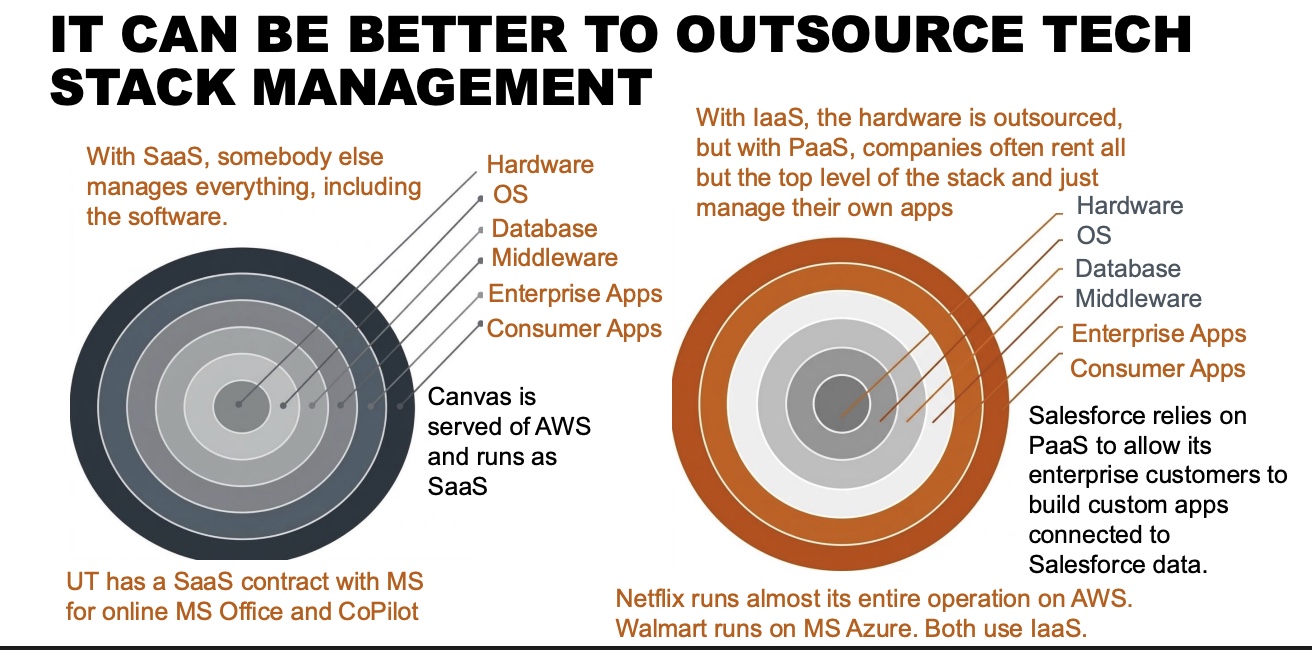
Platform as a Service (PaaS) & Infrastructure as a Service (IaaS) (click to view)
IaaS provides raw computing resources like servers and storage. PaaS provides a platform for developers to build applications. SaaS sits on top and delivers complete applications to end users.
The key difference is who manages each layer of the technology stack.
Key Relationships You Should Understand
- Cloud computing shifts computing from ownership to access.
- SaaS changes software from a one-time purchase to a subscription model.
- IaaS → PaaS → SaaS represent increasing levels of abstraction.
- Cloud computing reduces upfront costs and increases scalability.
- Lower costs reduce entry barriers and increase competition.
- SLA agreements define reliability and performance expectations.
- Consumerization increases expectations for ease of use and accessibility.
Study Questions with Full Answers
1) Why would a firm choose to use SaaS?
Firms choose SaaS because it reduces upfront costs, eliminates the need for hardware ownership, and allows for easy scalability.
It also simplifies updates and maintenance since the provider manages the system.
2) What are the benefits and risks of SaaS?
Benefits include lower costs, scalability, accessibility, and reduced IT management.
Risks include dependence on providers, data security concerns, and potential downtime or service interruptions.
3) How do SaaS providers make money?
SaaS providers typically use subscription-based pricing models. Users pay regularly instead of making a one-time purchase.
This creates recurring revenue and allows firms to scale as their user base grows.
4) Why choose SaaS over traditional licensing?
SaaS offers flexibility, lower upfront costs, and easier updates. Traditional licensing requires larger upfront investment and more maintenance responsibility.
5) Why do entry barriers decrease with cloud computing?
Cloud computing removes the need for expensive infrastructure. New firms can launch with minimal upfront investment.
This makes it easier for startups to enter markets and compete with established firms.
6) What is the effect of lower entry barriers?
Lower entry barriers increase competition and allow more firms to enter the market.
Existing companies may face more pressure to innovate and maintain their advantage.
7) What are examples of AWS products?
AWS offers services such as computing power, storage, databases, and networking tools.
These allow firms to build and run applications without owning physical infrastructure.
High-Value Compare / Contrast
- SaaS vs Traditional Software: subscription vs one-time purchase.
- Cloud vs Local Computing: remote access vs local ownership.
- IaaS vs PaaS vs SaaS: infrastructure → platform → application.
- Upfront Cost vs Ongoing Cost: cloud shifts cost structure over time.
Application Practice
- Why might a startup prefer cloud computing over owning hardware?
- How does SaaS create more predictable revenue for firms?
- Why might large firms still hesitate to fully adopt SaaS?
- How does cloud computing increase competition in an industry?
- Why do SLAs matter when using cloud services?