How to Think About This Chapter
This chapter is not mainly about memorizing isolated definitions. It is about understanding how falling computing costs, improving performance, different kinds of hardware, and data-driven systems change products, business strategy, customer experience, and environmental impact.
A strong answer should connect technical ideas to business consequences. For example, do not just say that computing gets cheaper. Explain how that can increase demand, enable new products, change staffing decisions, shift work to the cloud, and create new waste problems.
Core Vocabulary and Concepts: Click Links for Helpful Graphics
eWaste
e-waste is discarded, often obsolete technology. The chapter emphasizes that the scale is huge, the materials can be toxic, and recycling is difficult because devices are small, complex, and often handled improperly.
Internet of Things (IoT)
IoT refers to tiny connected devices embedded into everyday objects. The chapter connects IoT to cheaper computing power and wearable devices, showing how lower-cost processing creates new uses.
Konana’s Model of the Software Ecosystem (click to view)
This model shows layers: hardware, OS, DBMS, middleware, enterprise, and apps.

Memory
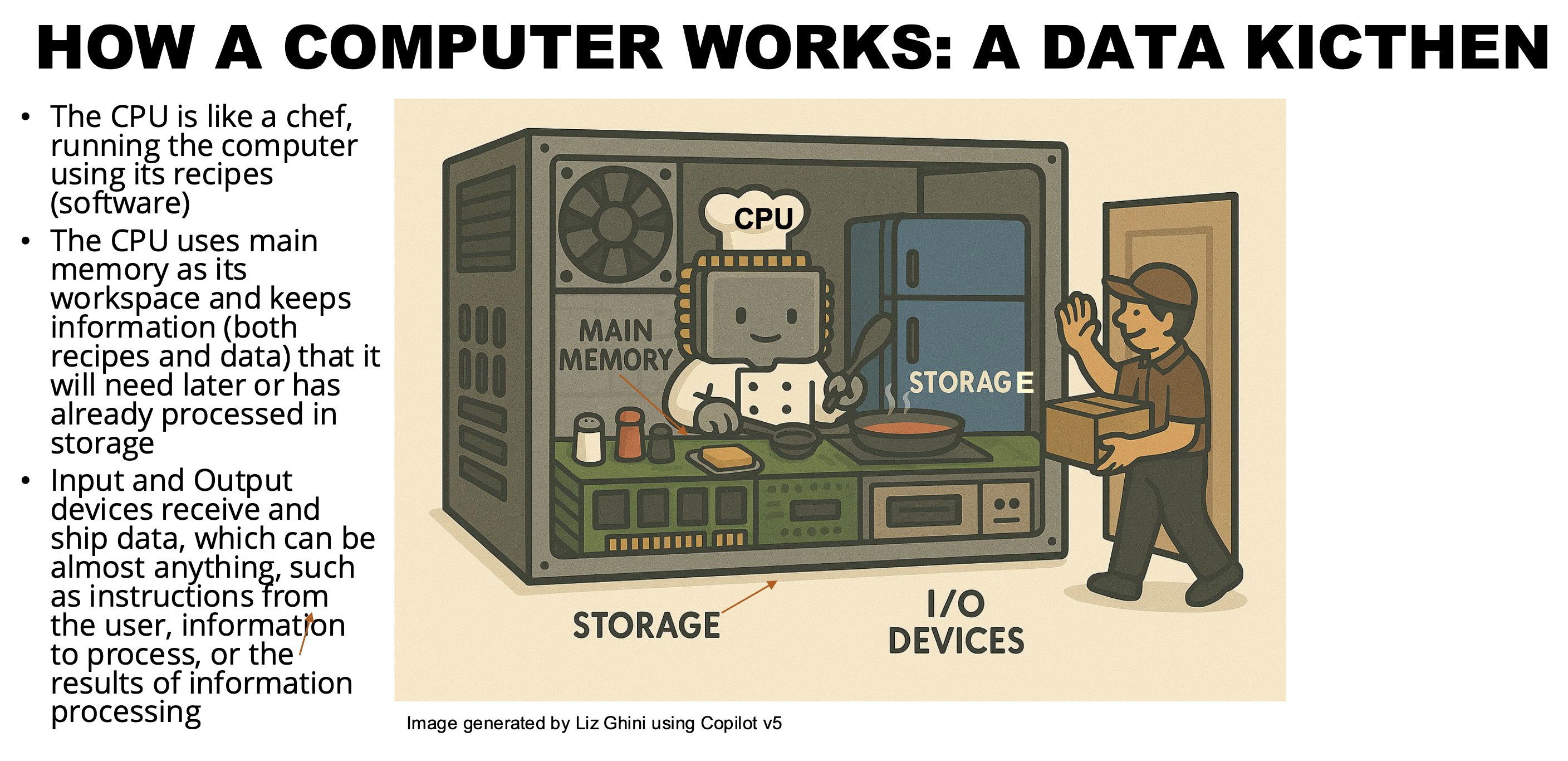
Memory is the computer’s working space. In the “data kitchen” analogy, the CPU uses main memory as its workspace while actively processing instructions and data.
Microprocessor
A microprocessor is the chip containing processor cores that perform calculations. Modern devices usually use multicore microprocessors, which can perform better while using less power and producing less heat.
Moore’s Law
Moore’s Law is an observation, not a law of physics. It describes exponential growth in computing capability and became an industry expectation for the pace of innovation.
Volatile vs. Non-volatile Memory
Volatile memory loses its contents when power is removed. Non-volatile storage keeps data even when power is off. This is why memory is for active work and storage is for long-term keeping.
Computers as Data Kitchens (click to view)
The CPU is like a chef, software is like recipes, memory is the workspace, storage holds information for later, and input/output devices bring in and send out data.
Price Elasticity of Demand
When price falls, demand rises. The chapter stresses that demand for computing power is highly elastic: as computing becomes cheaper, people want more of it and invent new uses for it.
Quantum Computing
Quantum computing uses qubits instead of only 1s and 0s. It promises dramatic gains for some problems, but it is not yet commercially feasible for everyday users.
Storage
Storage keeps data for later use. In the chapter, storage is different from memory because it is where information is kept after processing or until it is needed again.
Volatile
Volatile means the data disappears when power is lost. This is why volatile memory is useful for active tasks but not for permanent saving.
Parallel Computing
Parallel computing means using many processors or cores at the same time. This appears in multicore CPUs, supercomputers, cluster computing, grid computing, GPUs, and cloud processing.
Storage Capacity vs Bandwidth vs Latency (click to view)
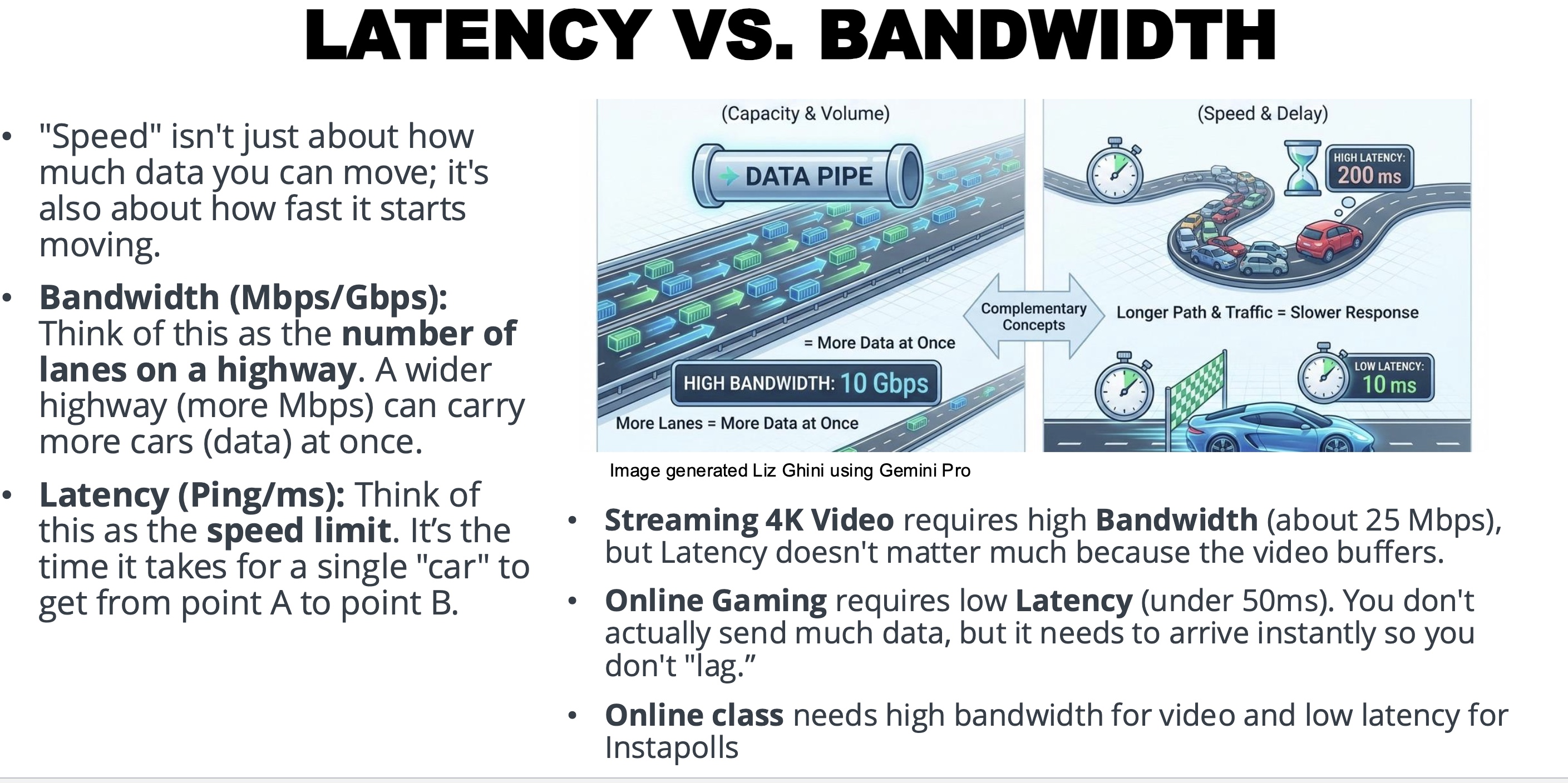
Capacity is how much data can be stored. Bandwidth is how much data can move at once. Latency is how long it takes for data transfer to begin or arrive.
Key Relationships You Should Be Able to Explain
- Moore’s Law helps explain why computing becomes faster and cheaper over time.
- When computing gets cheaper, demand rises because computing power is highly price elastic.
- Rising demand enables cloud services, AI, tiny wearables, and IoT devices.
- More computing also changes business operations like planning, staffing, inventory, and scheduling.
- More devices and faster replacement cycles also increase e-waste and recycling challenges.
- Cloud computing offers powerful parallel processing, but it adds latency and security concerns for data in transit.
- Disney’s MagicBand shows how embedded technology can improve customer convenience while also giving the firm valuable data and efficiency gains.
- Konana’s ecosystem explains why hardware changes can affect software compatibility and why firms care about lock-in.
Study Questions with Full Answers
1) What hardware components make up a modern laptop computer, and what does each do?
A modern laptop includes a CPU or microprocessor, memory, storage, and input/output devices. The CPU runs the computer by carrying out software instructions. Memory serves as the active workspace for the CPU. Storage keeps information for later use, including both data and software. Input and output devices receive and send data, such as user instructions, information to process, and the results of processing.
You should also understand that chips are built from semiconductors and transistors. A transistor acts like a switch that represents binary data as 1s and 0s. Billions of transistors can be packed together into a chip to perform complex computations.
2) What is Moore’s Law, and why should managers care?
Moore’s Law is the observation that computing capability grows exponentially over time. The slides also stress that it became a business plan for the semiconductor industry because firms expected innovation to continue at that pace.
Managers should care because rapid improvement in computing changes what products are possible, how cheaply they can be delivered, and how quickly markets shift. Managers are often blindsided by the rate and disruptive capabilities of technological change, so understanding this trend helps with strategic planning.
3) How has Moore’s Law enabled the IoT, cloud, and AI?
As computing power gets cheaper and more capable, firms can place processing into smaller and cheaper devices, which helps enable the Internet of Things and wearable products. Falling cost also supports cloud computing, where firms can offload complex tasks to large parallel systems. AI especially benefits because it requires intense computation, and the chapter notes that almost all AI processing is done in the cloud.
The larger idea is that cheaper computing does not just improve existing products. It creates entirely new uses. That is the connection between Moore’s Law and price elasticity of demand for technology.
4) What are the managerial implications of faster and cheaper computing for strategic planning, inventory, and accounting?
Strategically, managers must expect computing improvements to reshape industries and customer expectations. If they assume technology changes slowly, they can be caught off guard.
For inventory and operations, better computing and analytics improve forecasting, scheduling, and resource allocation. Disney is the best example in the slides: data helps determine staffing at rides and restaurants, how to stock food and souvenir locations, and how many cast members are needed in different parts of the park.
For accounting and transaction processes, faster systems can reduce transaction time and scale capacity. Disney cut turnstile transaction time by 30 percent and was able to serve thousands of additional guests per day. The managerial point is that information systems can create both efficiency gains and revenue gains.
5) How could quantum computing dramatically increase computing capabilities, and why is it not yet available to everyday users?
Quantum computing uses qubits rather than only standard binary bits. The chapter connects this to future capabilities such as hyperdetailed representations of the human body, predicting weather months in advance, and unbreakable computer security.
It is not available to everyday users because it is not yet commercially feasible. So the test idea is not “quantum exists, therefore everyone uses it,” but rather “quantum has extraordinary potential, yet practical adoption remains limited.”
6) What is the difference between memory and storage, and what should you know when buying a computer?
Memory is the computer’s temporary workspace for active processing. Storage is where information is kept for later use. Memory is tied to speed while working; storage is tied to how much you can keep and retrieve later.
You should also know the distinction between volatile and non-volatile forms. Volatile memory loses its contents when power is off, while storage preserves data.
When buying a computer, do not confuse storage size with speed of active work. Also do not confuse storage units with transfer speeds. Storage is measured in bytes, while transfer speeds are often measured in bits per second. Since 8 bits equal 1 byte, advertised transfer rates can sound larger than the actual number of megabytes per second you experience.
7) What is the magnitude of the environmental problem caused by rapid computing improvement and obsolescence?
The chapter presents this as a major global issue. Global e-waste reached 62 million tons in 2022 and is projected to rise to 74 million tons by 2030. The amount discarded in a single year is compared to throwing away all commercial aircraft ever built.
The harm is not only volume. e-waste contains toxic substances such as lead, cadmium, and mercury, which can contaminate soil and water when recycling is done poorly. Recycling is hard because parts are tiny and varied, enforcement is weak, and it can be cheaper to ship waste abroad than recycle it properly.
8) What value did Disney gain from embedding technology into manual experiences, and what value did customers get?
Customers gained convenience and smoother experiences. MagicBand can be used for park admission, hotel room entry, purchases, and even locating guests for meal delivery. MyMagic+ also helps reduce line time by booking ride reservations and spreading guests out.
Disney gained data, efficiency, and revenue. The system helps Disney know when to add staff, how to stock locations, and how to deploy cast members. Disney cut transaction time by 30 percent, served 3,000 to 5,000 additional guests per day, and guests spent more money.
This is an example of embedded technology turning operational data into strategic advantage.
High-Value Compare / Contrast Points
- Memory vs Storage: workspace now versus saved for later.
- Volatile vs Non-volatile: disappears without power versus retained without power.
- Bandwidth vs Latency: amount of data moved versus delay before data arrives.
- CPU vs GPU-style AI processing: general processing versus highly parallel designs suited for AI workloads.
- Cloud processing vs local processing: more remote computing power versus more latency and more data-in-transit concerns.
- Innovation benefits vs innovation costs: better products and efficiency versus e-waste, energy use, and dependence on concentrated chip production.
Application Practice
Use these prompts to practice answering with connected reasoning.
- If a product becomes dramatically cheaper to compute, what new customer use cases might appear?
- Why might a manager choose cloud computing even if latency is a drawback?
- How can a company improve customer experience and at the same time collect data that improves operations?
- Why can a hardware shift create software problems even when the new chip is better?
- Why does faster innovation create both strategic advantage and environmental cost?